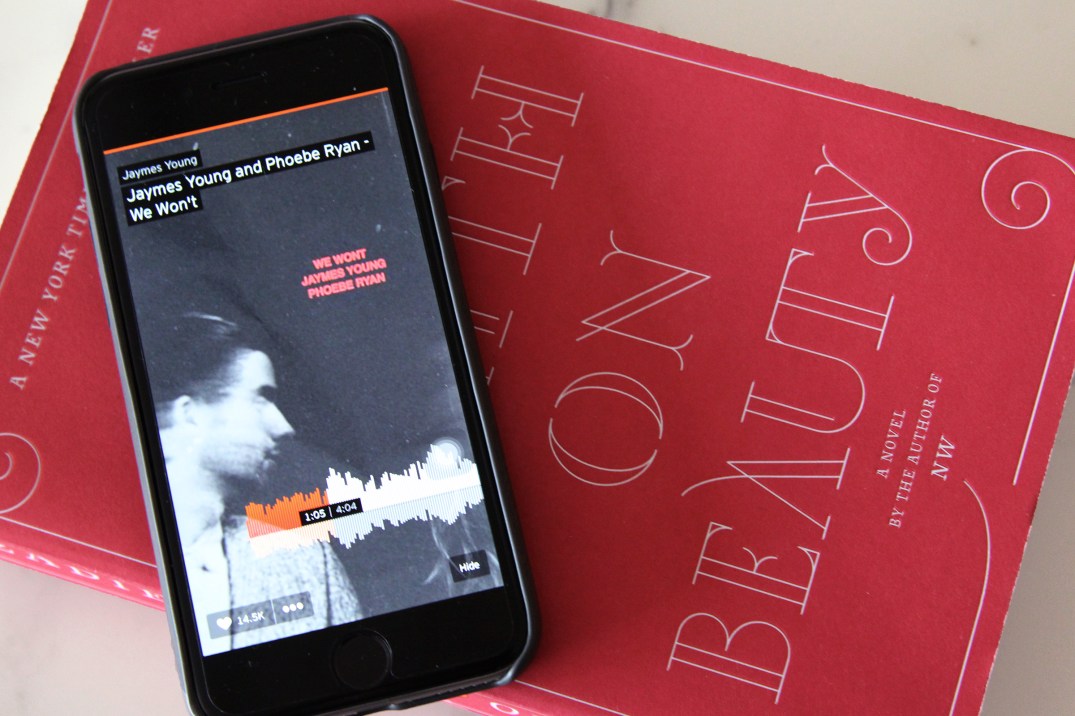
In May, I showed my summer reading list to a well-read friend of mine. She said, “Did you know that this [On Beauty by Zadie Smith (2005)] was based on this [Howards End by E.M. Forster (1910)]?” I did not. What were the chances? I decided to read them back-to-back.
Synopses
Howards End explores early 20th-century English society through the stories of three families. They are: the half-German, orphaned Schlegels (Meg, Helen, Tibby), who are wealthy, educated, socially progressive intellectuals; the Wilcoxes, who made large fortunes through England’s colonies and take pride in their unphilosophical practicality; and the Basts — a loveless, lower-middle-class couple.
On Beauty engages early 21st-century England and Northeast US through a similar intertwining of unlike families. There are the Belseys, composed of a white English father, a black Floridian mother, and their three children. Then there is their foil, the Kippses — a black, conservative, Christian family based in London. The rivalries between the two families come to a boiling point when the Kippses move to Wellington College, the (fictional) liberal arts college in Massachusetts where both fathers teach. There, racial frustrations manifest in intellectual competition, which is then complicated by teenage and middle-age lust. Meanwhile, the “charity project” role goes to Carl, a black boy who embodies both the potential of the underprivileged and the more “authentic” black culture that the mixed-race, middle-class Belsey children fail to partake in.
Quotes – Howards End
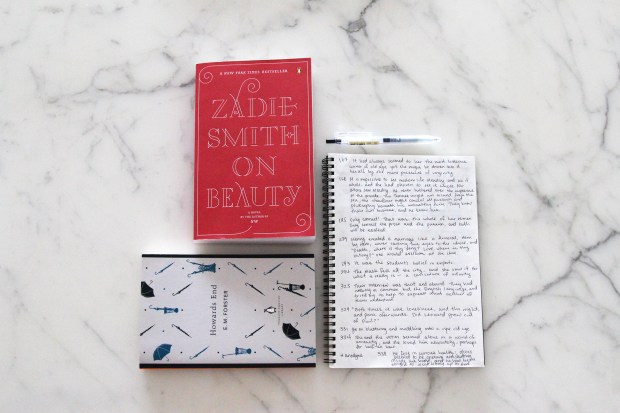
1. ‘It is sad to suppose that places may ever be more important than people,’ continued Margaret.
‘Why, Meg? They’re so much nicer generally.’
2. Science explained people, but could not understand them.
Quotes – On Beauty
1. ‘Oh, I’m so sorry your dick offends your intellectual sensibilities. It must be terrible. There’s your subtle, wonderful, intricate brain and all the time it turns out your dick is a vulgar, stupid little prick. That must be a real bitch for you!’
2. Harry surely hadn’t meant to tell his only son that you couldn’t expect black people to develop mentally like white people do. He had meant to say: I love you, I love my grandchildren, please stay another day.
Thoughts
Getting to the point before I move away from it: I loved both books. A lot.
Less straightforward thoughts: aside from a facetious mention of Forster (Howard smiled sadly. ‘Can’t stand Forster.’) near the end of the novel, On Beauty does not directly acknowledge its connection to Howards End. It’s more of a private joke with those who have already read Howards End or have scrolled all the way down On Beauty’s Wikipedia page. To anyone else, this would have just been a good book with a slightly strange opening line (‘One may as well begin with Jerome’s emails,’ matching ‘One may as well begin with Helen’s letters’).
This is a real shame. Not that everyone should read these two back-to-back, but, well, yes, you should. While On Beauty certainly stands on its own, reading the two together forced me to think much more carefully about the complexities of “modern life” as we know it and how they have changed in the past century. Where concerns with class difference and the inability of the poor to get an education lay before, race has been tossed into the mix and the debates have grown more nuanced. One memorable dialogue takes place between Kiki Belsey and Monty Kipps, who are both black and educated but disagree on affirmative action:
‘As long as we encourage a culture of victimhood,’ said Monty, with the rhythmic smoothness of self-quotation, ‘we will continue to raise victims. And so the cycle of underachievement continues.’
‘Well,’ said Kiki… ‘I just think it stinks of a kind of, well, a kind of self-hatred when we’ve got black folks arguing against opportunities for black folks.’
On another note, it was also interesting to see how the nature of sex scandals have, uh, evolved, both physically and psychologically. Where it was “rich man has affair with lower-class woman” before, Smith has written “old friends sleep together due to compulsion to ruin the happiness of others” and “18 year-old dresses in garters to seduce married professor after emailing nude photographs.”
While these are just two of many issues addressed in these novels, the general unspoken trend seems to be, depressingly, this: as we advance in technological conveniences and work toward equal opportunity, we also give ourselves more room to dig deeper in to society’s preexisting rabbit holes. It’s a sad message, but in both books, at least there’s plenty of humor in the delivery.

Soundtrack
I usually don’t like it when lyrics are directly applied to plots, but Jaymes Young’s new single “We Won’t” grew more and more appropriate for On Beauty the more I read:
Don’t go to war for me
I’m not the one that you want me to be

 Inklings